Chrissy Teigen has 39 million followers and has not walked a runway in years. Liu Wen has a fifth of that and opened almost every door the rest of them walked through. That gap is the whole story of Asian Instagram models in one line.
Fifteen years ago an Asian face on a Western campaign was a talking point. Liu Wen walked Victoria’s Secret in 2009 and it made news. Today a Korean makeup artist sells her own cosmetics line internationally. A Filipino screen star has more followers than most European magazines have readers. A woman discovered because Justin Bieber posted her photo now shoots Sports Illustrated. The casting board stopped being the only way in.
Top Asian Instagram Models at a Glance
Five accounts clear 10 million followers. The distance between first and twentieth is 38 million, wider than the entire readership of most national fashion magazines.
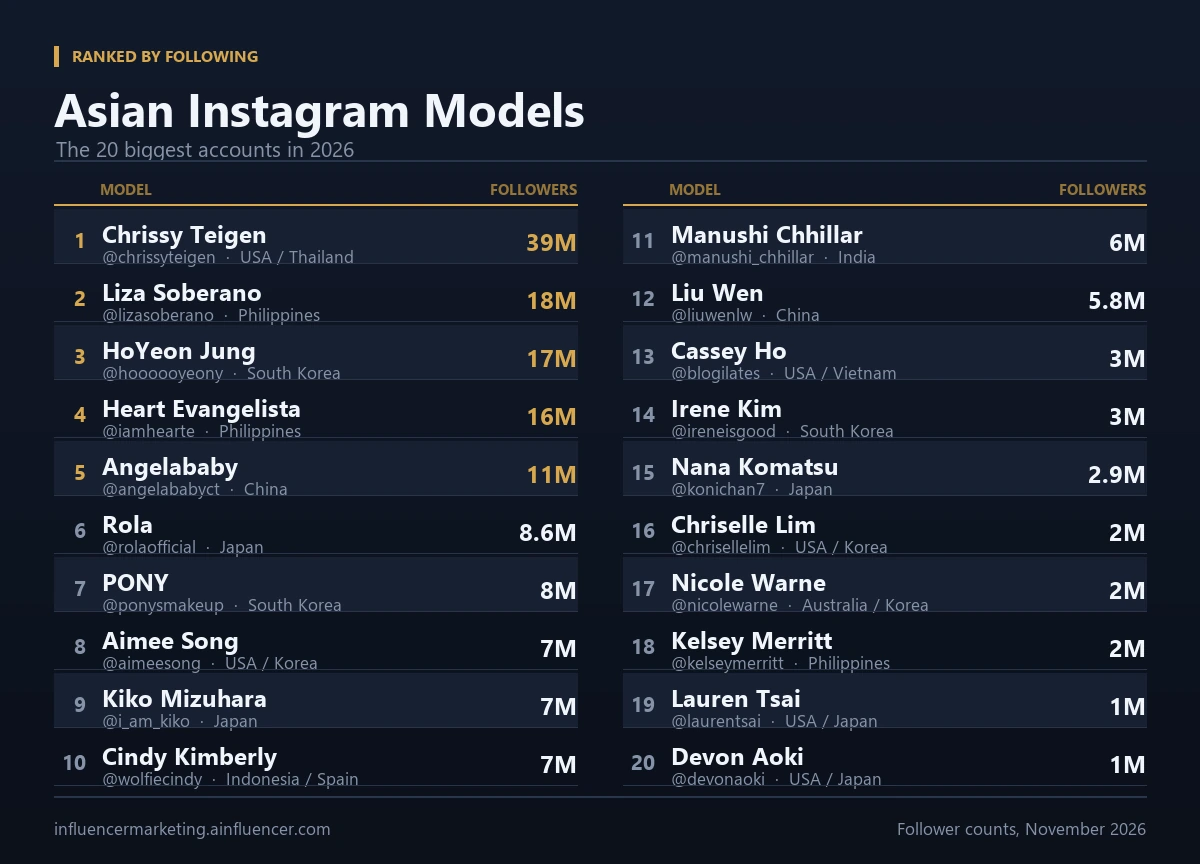
20 Hottest Asian Instagram Models to Follow in 2026
An SI Swimsuit rookie in 2010, Chrissy Teigen had the cover by 2014. Her mother, Vilailuck, is Thai, and Thai cooking runs through the Cravings cookbooks that turned her into a food brand.
No account in this category comes close to her reach. She is also the clearest proof that the hottest Asian Instagram models rarely stay models. The modelling paid for the platform. The platform built everything after it, and she still out-earns most Instagram influencers who never left fashion.
Born in Virginia to a Filipino father and an American mother, Liza Soberano moved to the Philippines as a child and became one of its biggest screen stars. She relocated to Los Angeles to chase Hollywood work and landed a role in Lisa Frankenstein.
Very few names carry the Philippines and the United States at the same weight. She is the single biggest Asian Instagram model account tied to Southeast Asia, and the Filipino influencers who came after her grew up watching her on television.
HoYeon Jung was already one of the most-booked runway models in the world, with a Louis Vuitton exclusive in Paris. Then Squid Game made her a global name and won her a SAG Award. Louis Vuitton made her a house ambassador in 2021.
She is the one entry here who went the other way, from fashion into film, and kept both. For luxury houses she is the reference point on any shortlist of top Asian Instagram models. Her feed still reads like a model’s: campaigns, editorials, backstage. She opened a door a generation of Korean influencers walked through behind her.
Schiaparelli invited Heart Evangelista to her first fashion week in 2016 and she has not missed a season since. She made her Paris runway debut in March 2024, opening for the Vietnamese designer Phan Huy, and Mugler named her its Southeast Asia ambassador in 2025.
Photographers crowd her on the pavement before she reaches the door, which is the real measure of a street style draw. Among the hottest Asian influencers working the European circuit, nobody from Southeast Asia gets photographed more. The houses book her alongside the fashion influencers they fly in from Milan.
Angelababy signed with an agency at 14 and became one of the most photographed faces in Chinese-language media before moving into television and film. Dior has used her as an ambassador for the Chinese market.
Her audience spans the mainland, Hong Kong, Taiwan and the diaspora at once, which almost nobody else manages. For a luxury or beauty launch aimed at Chinese consumers she remains the safest booking among Asian models Instagram has made globally visible. No other Chinese influencer carries that combination of screen fame and luxury trust.
Rola came up through Tokyo teen magazines and became one of the most recognisable faces on Japanese television. Bangladeshi, Japanese and Russian heritage gave her a look nobody else on those shows had. She later moved to Los Angeles to build an international career.
The feed runs on fashion, wellness, cooking and environmental work rather than pure modelling. That mix is why brands use her to reach Japan and the West in one booking, and why she outranks nearly every other Japanese influencer on raw following.
Park Hye-min started posting looks on Cyworld, taught herself everything, and became CL’s makeup artist, touring with 2NE1. The South Korean Makeup Association named her Makeup Artist of the Year in 2011. A style book followed in 2014, then a place on the Forbes 30 Under 30 Asia list in 2017.
She launched PONY Effect through Memebox in 2015 and still works as a regional colour artist for Shiseido. Dior and Bobbi Brown book her anyway, which almost never happens once a creator has a competing label. Her YouTube channel passed 4.4 million subscribers along the way.
Aimee Song started blogging in 2008 while studying interior architecture in San Francisco. Song of Style grew into a fashion line made exclusively for Revolve, an interior design practice, and two books. The first, Capture Your Style, was a New York Times bestseller.
This is a founder who models her own work, not a model who took sponsorships. Of the Asian Instagram influencers female audiences have followed for a decade or more, the Korean-American creator has the longest unbroken run. She belongs with the top female Instagram models by reach alone.
Dallas-born and Kobe-raised, Kiko Mizuhara was discovered by Seventeen Japan as a teenager. Dior and Coach campaigns followed, alongside acting work in films including Norwegian Wood, and she has designed her own collections.
Nobody in Japanese fashion art-directs a grid this tightly. The content reads as a project rather than a feed, which is why creative-led brands pick her over bigger accounts.
Justin Bieber posted Cindy Kimberly’s photo in 2015 asking who she was, and she woke up famous. The Amsterdam-born model of Indonesian and Spanish descent turned that accident into a GQ Spain cover and a Sports Illustrated Swimsuit rookie debut in 2022.
Hers is the only story here that began and ended on the platform itself, which makes her the literal answer to what Asian IG models means. She wipes her grid down to a handful of posts at a time, so each one lands harder. She fits the same brief as the Instagram bikini models booked every swim season.
Manushi Chhillar won Miss World in 2017 while still a medical student, then made her Bollywood debut in Samrat Prithviraj in 2022. Cannes appearances and beauty campaigns followed.
India and the South Asian diaspora make up almost all of this following, which is a different buy from the East Asian accounts above her. Brands looking for Asian female models who can carry a jewellery or bridal campaign in that market usually start and finish with her.
Liu Wen is routinely called Asia’s first supermodel, and the firsts back it up. First East Asian model to walk Victoria’s Secret, in 2009. First Asian face of Estée Lauder. First Asian model on the Forbes highest-paid list.
Every one of those doors had to be opened before anyone else could walk through it. The feed stays editorial and quiet, and she is still the name brands entering China want attached to a launch.
Cassey Ho filmed her first Blogilates video in 2009. She was leaving California for Boston and wanted her students to keep following along. By 2014 it was the biggest fitness channel on YouTube. The daughter of Vietnamese immigrants launched POPFLEX in 2016 and still runs it as CEO and head designer, without outside investors.
Taylor Swift wore the brand’s Pirouette skort in 2024 and it sold out in 15 minutes. That is a different business from sponsorship, and it explains why Instagram Asian models with product lines price themselves like founders. Few Asian fitness influencers have turned an audience into a manufacturing business.
Seattle-born and Seoul-based, Irene Kim built her name on pastel hair and a street-style sensibility that made her a front-row fixture in Paris, Milan and New York. Estée Lauder made her a global ambassador.
K-beauty brands use her when they need a face that reads in both Seoul and the West, which is rarer than it sounds. Among Asian insta models she is the most consistent bridge between the two markets, and the same audience follows the Asian TikTokers driving K-beauty trends week to week.
Nana Komatsu is a Chanel ambassador and one of Japan’s most praised young actresses, with credits that include Martin Scorsese’s Silence. She started as a model and has never lost the eye.
Quiet, cinematic and heavily Chanel, the feed is precisely what a luxury partner wants. Her audience sits almost entirely in Japan and greater Asia.
Chriselle Lim trained as a wardrobe stylist and started posting styling tutorials when almost nobody was doing it. The Korean-American creator built that into a fashion and beauty audience in the millions and has since moved into founding and running her own companies.
Her content assumes you want to be taught something, not just shown an outfit. That tutorial instinct is why beauty launches keep returning to her a decade in, while flashier accounts churn.
Nicole Warne was adopted from Busan, South Korea at five months old and raised in Australia. She quit her job in 2009 to run an eBay store called Gary Pepper Vintage, turned it into a blog, and ended up fronting Louis Vuitton and Chanel. One Lancôme collaboration drew more than 60,000 Instagram shares in a day.
She now works with Adopt Change on adoption awareness in Australia, and talks about being a Korean adoptee openly rather than as a footnote. Brands get the creator who wrote the commercial playbook everyone else borrowed.
Kelsey Merritt walked the Victoria’s Secret Fashion Show in 2018, the first Filipino model to do it, and has fronted Maybelline campaigns since. She grew up in Pampanga and is now based in the United States.
The tone is warm and approachable rather than untouchable, which converts far better for swim and beauty. Searches for hot Asian Instagram models surface plenty of accounts that cannot sell a product. Hers can.
Lauren Tsai left Hawaii for Tokyo as a teenager to model. Terrace House made her a favourite. She then built parallel careers as an illustrator and an actress, with a role in the FX series Legion.
Her own artwork sits beside the modelling work in the same feed, which is unusual and keeps the engagement rate well above what the follower count suggests. Streetwear and creative brands find her first.
Devon Aoki fronted Versace at 16 and became one of the defining models of the late 1990s. Film followed, with 2 Fast 2 Furious and Sin City. Her father, Rocky Aoki, founded Benihana.
Archive fashion is having a long moment and she owns more of it than anyone here. Heritage houses book her precisely because the audience already associates her with the era they are reissuing.
Where Asian Models Come From, and Why It Matters
Four markets feed this category and they behave nothing alike.
Korea exports technique. Its biggest beauty names are artists before they are faces. PONY was CL’s makeup artist and won a national award for it before launching her own line. Irene Kim became a front-row fixture on the strength of pastel hair and styling, not measurements. K-beauty travels because the people selling it can actually do the thing.
Japan exports crossover. Kiko Mizuhara, Nana Komatsu and Lauren Tsai all model and act, and the acting is not a sideline. Japanese agencies have treated the two as one career for decades, which is why a Chanel ambassador here is also likely to turn up in a Scorsese film.
China exports commercial scale. Liu Wen and Angelababy reach an audience no Western platform measures properly, because most of it sits on Weibo and WeChat rather than Instagram. The Instagram number understates them badly, and brands entering China price them accordingly.
Southeast Asia exports domestic fame. Heart Evangelista and Liza Soberano carry followings that rival European pop stars, almost entirely inside the Philippines and its diaspora. A campaign running in Manila gets extraordinary value. The same campaign running in Berlin does not.
What Changed for Asian Models Since 2009
The usual starting point is 2009, when Liu Wen walked Victoria’s Secret. The firsts came quickly after it. First Asian face of Estée Lauder. First Asian model on the Forbes highest-paid list. Kelsey Merritt became the first Filipino model on that same runway in 2018. Nine years is a long time for a second.
The platform moved faster than the industry did. Cindy Kimberly was discovered in 2015 because a pop star posted her photo, and she had a GQ cover before she had an agency relationship worth the name. Cassey Ho filmed workouts in 2009 for a few students and now manufactures activewear. Nicole Warne was selling vintage on eBay.
Luxury is the part the industry still controls. Louis Vuitton, Chanel, Dior and Estée Lauder ambassadorships still go to women with runway or screen credentials, which is why HoYeon Jung and Nana Komatsu sit where they do. What the industry no longer controls is who gets an audience in the first place.
Conclusion
Twenty women, nine countries and three entirely different routes in. Some were signed at 16. Some were posted by a stranger with 100 million followers. Some built the audience themselves and waited for the industry to catch up.
A follower count tells you how many people are watching. It says nothing about where they live or whether they buy. Liu Wen at 5.8 million is worth more to a luxury launch in Shanghai than anyone above her here.
Frequently Asked Questions
Who is the most followed Asian model on Instagram?
The biggest account belongs to Chrissy Teigen at 39M, and she is a genuine model. Sports Illustrated Swimsuit rookie in 2010, cover star by 2014, Thai mother. If you mean someone still working primarily as a model, HoYeon Jung at 17M is the honest answer. Liu Wen remains the most influential of them all on a far smaller following.
Who is the most famous Asian model?
The strongest claim belongs to Liu Wen, and the record backs it. First East Asian model to walk Victoria’s Secret. First Asian face of Estée Lauder. First Asian model on the Forbes highest-paid list. Outside fashion circles HoYeon Jung is better known, because Squid Game reached an audience no runway ever will.
Who was the first Asian supermodel?
That title usually goes to Liu Wen. Her 2009 Victoria’s Secret appearance is treated as the moment the Western industry stopped filing Asian models under regional bookings. Devon Aoki came earlier in a different way. She fronted Versace at 16 in the late 1990s, a Japanese-American model at a point when almost nobody in fashion discussed representation at all.
Which Asian countries produce the most Instagram models?
Korea, Japan, China and the Philippines dominate, and each sends a different kind of talent. Korea produces beauty specialists and K-fashion faces. Japan produces models who also act. China produces runway and luxury ambassadors whose real audience sits on domestic platforms. The Philippines produces screen stars with enormous home followings. India, Indonesia, Thailand and Vietnam appear too, usually through pageant routes.
Who is the highest paid Asian model?
For fashion earnings the reference point is Liu Wen, the first Asian model to reach the Forbes list of the world’s highest-paid models. On total income the answer is probably Chrissy Teigen, although cookbooks, television and a product business earn most of that rather than modelling. Rates in this category depend far more on which market a woman unlocks than on her follower count.
How do Asian models get discovered on Instagram?
Three routes show up repeatedly. Someone with a huge audience posts your photo, which is exactly what happened to Cindy Kimberly in 2015 when Justin Bieber shared hers. You build an audience doing something specific, the way Cassey Ho did with workout videos and PONY did with makeup tutorials. Or an agency finds you the traditional way and the platform amplifies everything that follows, as it did for HoYeon Jung.
Are Japanese or Korean models bigger on Instagram?
Japanese accounts tend to be larger individually, because Japan’s television and film industries feed huge crossover followings. Rola sits at 8.6M and Kiko Mizuhara at 7M. Korean names are often smaller but convert harder in beauty, since K-beauty exports give them a product to sell. PONY at 8M and Irene Kim at 3M both monetise through cosmetics rather than campaign fees.