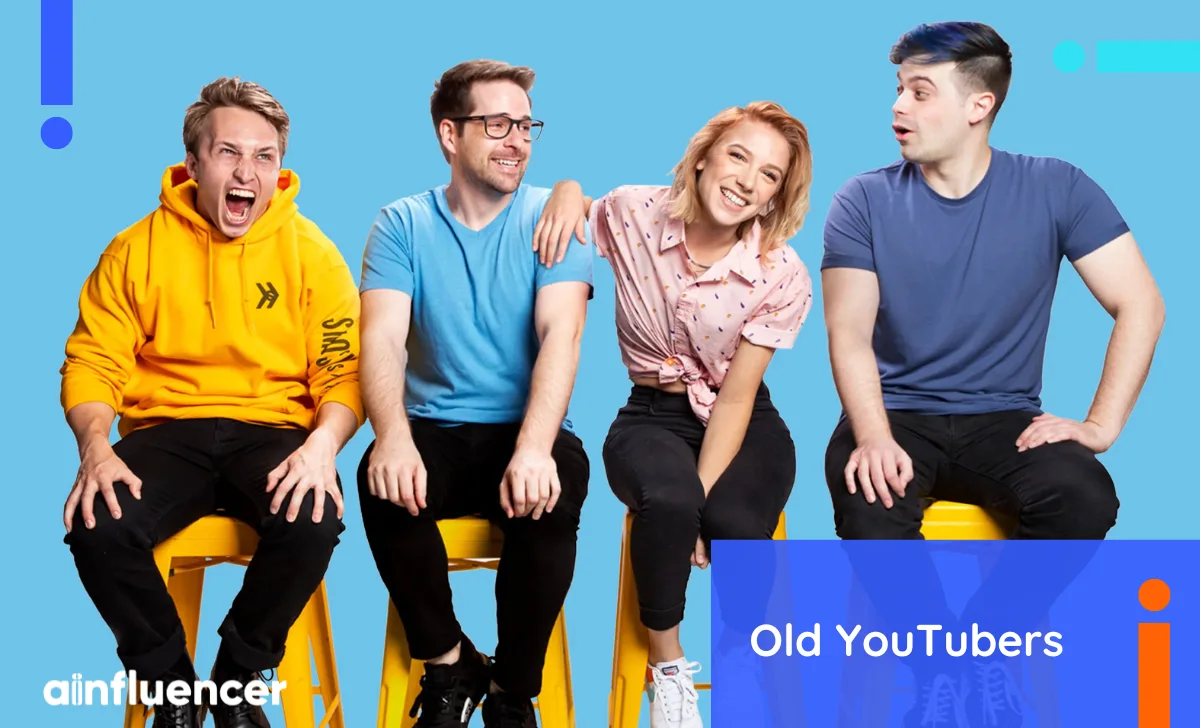
Most channels that opened in 2005 are gone, and the few still uploading are the closest thing this platform has to institutions. Every channel below was created before 2012, several of them before YouTube had a working business model. These 15 old YouTubers are ranked by live subscriber count, with each channel’s latest uploads playing underneath.
Age is a poor thing to rank on, so this list does not rank on it. The order is subscribers and the launch dates sit beside them, which is how you see what eighteen years of compounding actually buys. For how that gets priced, see our guide to YouTube influencer marketing.
Best Old YouTubers to Follow in 2026
Ranked by subscriber count, these are the 15 top old YouTubers still publishing today, each with a live channel embed showing their most recent uploads. The list runs from a Swedish gaming channel past a hundred million down to one of the first people who ever vlogged for a living.
Felix Kjellberg started uploading horror game commentary from Sweden in 2010 and spent most of the decade that followed as the most-subscribed person on the platform. The channel now looks nothing like that beginning: chess, oil painting, book reviews, and family life in Japan.
No creator has rebuilt an audience this size this many times and kept it. He takes very few sponsorships now, which makes him more valuable as a lesson in longevity than as a line on a media plan.
The channel began with a basketball trick shot filmed on a Texas ranch in 2009 and became the biggest sports entertainment property on the platform. The format has barely changed in seventeen years, which here counts as a strategy rather than a failure to evolve.
It is also the most family-safe channel at this scale anywhere, which is why the sponsor list reads like a Super Bowl ad break. They sit at the front of every shortlist of YouTube influencers built for mainstream budgets.
Seán McLoughlin opened his account in 2007 and spent years on it before the Let’s Play videos found an audience, which is the part most timelines skip. The volume and the shouting are the brand, and the consistency underneath them is why it lasted.
He has since built a coffee company and a clothing line, and he talks about burnout more openly than almost anyone at this level. Gaming hardware, software, and mental health campaigns all sit naturally against this channel.
Smosh is the oldest account here, opened in November 2005, roughly nine months after YouTube existed at all. Ian Hecox and Anthony Padilla were making lip-sync videos in a bedroom and accidentally worked out what an internet sketch channel should look like.
The channel was sold, passed through two corporate owners, and then bought back by its founders in 2023, which almost never happens. It now runs as a small studio with an ensemble cast and a genuinely renewed audience.
Evan Fong built one of the largest gaming channels on the platform without ever being the main thing on screen. The videos are tightly edited compilations of a group of friends playing badly on purpose, and the timing of the cuts is the entire craft.
Faceless formats age unusually well, because nobody watching has to watch a person get older. The tradeoff for a brand is that the personality is spread across a cast, so integrations work better inside the gameplay than read to a lens.
Michael Stevens took questions nobody says out loud, like what would happen if the Earth stopped spinning, and answered them at length and in order. Vsauce made dense explanation feel like entertainment years before the algorithm started rewarding it.
Uploads are rare now, which limits the channel as a campaign vehicle, but the back catalog still pulls enormous traffic every month. It remains the reference point every educational creator on YouTube gets measured against.
Marques Brownlee reviewed a cheap laptop in his bedroom in 2008 and has covered nearly every significant consumer device since. The production improved beyond recognition over eighteen years while the editorial voice stayed almost exactly the same.
He is one of very few reviewers whose verdict moves a share price, and he has been blunt about products made by companies that advertise on his channel. That independence is what makes him expensive, and our list of tech brands looking for influencers shows the queue he sits at the front of.
Derek Muller started Veritasium in 2010 while finishing a doctorate in physics education, and the thesis is visible in every video: show the misconception first, then take it apart. That structure has since been copied across the entire science side of the platform.
The channel takes sponsorship from technical and education brands and discloses it plainly at the top of the video. Anything that needs a real explanation rather than a slogan gets far more out of this format than out of a feed post.
Rhett McLaughlin and Link Neal have been filming a daily show in the same two chairs since 2012, on a channel opened in 2008, and have published well over two thousand episodes. Output at that rate is closer to broadcast television than to online video.
The pair own their studio, their staff, and a production company that now makes shows for other creators. Food and consumer brands get placed inside a daily habit here, which is worth considerably more than a single large moment.
Equals Three was the most-subscribed channel on the whole platform in 2011, built on reacting to viral clips before reaction was a recognized genre. Ray William Johnson then left it, tried animation and film, and eventually came back to commentary.
The channel now posts daily short-form takes on news and culture to an audience that mostly predates it. It is a useful measure of how much reach actually survives a decade away, which turns out to be more than most people assume.
Linus Sebastian began filming hardware segments for a computer retailer in 2008 and now runs a company of well over a hundred people with a purpose-built testing laboratory attached. The channel outgrew the store that paid for it within a few years.
The lab is the whole point. Very few creators anywhere can produce measurements a manufacturer is unable to dispute, and that capability turns a sponsorship conversation into something much closer to a supplier relationship.
Epic Rap Battles of History puts two figures who never met in a room and has them insult each other in verse. Peter Shukoff and Lloyd Ahlquist have been making them since 2010, on an account that dates back to February 2006.
Episodes arrive rarely and each one is an event with costumes, choreography, and a real production budget behind it. That scarcity is the model, which makes the channel a poor fit for volume campaigns and an unusually good one for a single launch.
Casey Neistat published a daily vlog for six hundred consecutive days and in the process settled what one looks like: a wide lens, a moving camera, and a story that actually resolves. Almost every travel creator working now borrowed that grammar from him.
He ended the daily run, sold a company to CNN, and now posts only when there is something worth saying. Camera, luggage, and airline brands fit him honestly, and our roundup of travel vloggers traces the lineage he started.
Destin Sandlin is an engineer who films what is normally too fast or too small to see, from a cat righting itself in midair to the working parts of a rocket motor. The curiosity is real and the access he gets is genuinely unusual.
His audience is older, more technical, and far more likely to buy tools than merchandise. Industrial, aerospace, and education partners get a kind of credibility here that consumer creators cannot manufacture at any price.
Justine Ezarik has been on camera since 2006, back when there was no accepted word for what she was doing. She was among the first people anywhere to make a full living as an internet personality, and she still uploads most days, usually about Apple hardware.
Twenty years of continuity is itself the asset. An audience that has followed one person that long treats a recommendation differently, and consumer technology, gaming, and lifestyle brands reach a viewer here who has been listening since before the first iPhone shipped.
Top Old YouTubers at a Glance
Here is the full ranking of the top old YouTubers side by side, sorted by subscriber count, with each channel’s handle, launch year, reach, and signature credit. Every channel was confirmed individually, and counts reflect September 2026 figures shown the way YouTube displays them.
| # | Creator | YouTube | Launched | Subscribers | Known For |
|---|---|---|---|---|---|
| 1 | Felix Kjellberg | @PewDiePie | 2010 | 109M | The most-subscribed individual creator in YouTube history, now reinvented several times over |
| 2 | Dude Perfect | @DudePerfect | 2009 | 62.7M | Trick shot channel that grew into the largest sports entertainment operation online |
| 3 | Seán McLoughlin | @jacksepticeye | 2007 | 31.2M | Irish Let’s Play creator who built one of the platform’s most durable gaming channels |
| 4 | Smosh | @smosh | 2005 | 27.1M | The oldest account on this list, and the channel that invented the YouTube sketch format |
| 5 | Evan Fong | @VanossGaming | 2011 | 26M | Canadian gaming channel built on edited friend-group chaos rather than a face on camera |
| 6 | Michael Stevens | @Vsauce | 2007 | 25.1M | The channel that made long, dense explanation feel like entertainment |
| 7 | Marques Brownlee | @mkbhd | 2008 | 21.3M | Bedroom reviewer turned the most trusted consumer technology critic on the platform |
| 8 | Derek Muller | @veritasium | 2010 | 21.3M | Science channel built on a doctoral thesis about why explanation usually fails |
| 9 | Rhett and Link | @GoodMythicalMorning | 2008 | 19.7M | Daily talk show with more than two thousand episodes shot in the same two chairs |
| 10 | Ray William Johnson | @RayWilliamJohnson | 2008 | 18.6M | Once the most-subscribed channel on YouTube, now rebuilt around daily commentary |
| 11 | Linus Sebastian | @LinusTechTips | 2008 | 16.9M | Computer store video segment that became a hundred-person company with its own lab |
| 12 | Epic Rap Battles of History | @ERB | 2006 | 15.1M | Costume-heavy rap battles between historical figures who never met |
| 13 | Casey Neistat | @casey | 2010 | 12.7M | Filmmaker who defined what a daily vlog looks like and then stopped making them |
| 14 | Destin Sandlin | @smartereveryday | 2006 | 11.9M | Engineer filming the things that happen too fast or too small to watch |
| 15 | Justine Ezarik | @ijustine | 2006 | 7.06M | One of the first people to make a living as an internet personality, still uploading daily |
Which Years Actually Produced the Survivors
2008 produced the most survivors and 2010 produced the most reach. Four channels here opened in 2008 and not one of them is the biggest; three opened in 2010 and between them they hold a third of every subscriber on this list. Volume and scale came out of different years.
Read down the left and the oldest accounts are not the largest, which is the useful correction to make. Age buys trust and an archive that keeps earning rather than raw size, and the archive is where a surprising share of the money sits. Our breakdown of how much YouTube pays explains the mechanism.
What a Twenty-Year-Old Channel Is Actually Selling
Nobody subscribes to these channels the way people subscribe to something new. The audience arrived years ago and simply stayed, which makes the relationship closer to a local radio host than to a feed. Recommendations land because the person making them has been consistent for longer than most brands have existed.
That should change what the brief asks for. Buy the creator’s judgment rather than a script, and expect a refusal on anything that would cost them credibility built over fifteen years. Our Ainfluencer review covers the mechanics, from filtering by niche and follower range to holding payment in escrow until the content is approved.
Conclusion
From Felix Kjellberg at number one to Justine Ezarik at number 15, these are the top old YouTubers of 2026, ranked on live subscriber counts and confirmed one channel at a time. Every account here was opened before 2012, and the list covers gaming, sketch comedy, science, tech review, sports, commentary, and vlogging.
A younger cohort reads well next to this one, which our roundup of the top British YouTubers covers. Pay for judgment rather than reach, price the archive alongside the upload, and keep in mind that the oldest channel here is nowhere near the largest.
Frequently Asked Questions
Who is the oldest YouTuber on this list?
Smosh, whose account was created on November 19, 2005, around nine months after YouTube itself was founded. The next oldest are Epic Rap Battles of History from February 2006, Smarter Every Day from April 2006, and iJustine from May 2006. No channel here was created later than September 2011.
How were these old YouTubers selected and ranked?
We shortlisted creator-run channels created before 2012 that are still publishing, then ranked them by live YouTube subscriber count in September 2026. Launch dates come from each channel’s own About page. Corporate channels, dormant channels, and anything created in 2012 or later were excluded, and every embed points at that channel’s own uploads playlist.
Which old YouTuber has the most subscribers?
PewDiePie, with 109 million. He held the title of most-subscribed channel on the platform for most of the 2010s and is still the largest individual creator here by a wide margin. Dude Perfect follows at 62.7 million, then jacksepticeye at 31.2 million and Smosh at 27.1 million.
Do older channels still get views, or only subscribers?
Both, though the split matters. A subscriber count built up over eighteen years includes a lot of people who stopped watching, so judge an older channel on recent view counts rather than the headline number. Several channels here average more views per video now than they did at their peak.
Are old YouTubers worth sponsoring in 2026?
For anything that needs explaining or trusting, yes. These creators have audiences that stayed with them for a decade or more, which converts very differently from reach bought cold. The limitation is frequency: several channels on this list post rarely, so plan around a small number of large placements rather than a schedule.
Why did so many original YouTubers stop uploading?
Burnout, mostly, and a platform that changed underneath them. The daily upload schedules that built these channels are not survivable for long, and several creators here took breaks of a year or more before returning. The ones still going have almost all rebuilt around a team rather than a single person.