Ainfluencer Review: Features, Pricing, and Fit
What the platform does, what it costs, and an honest account of who it suits and who would be better served elsewhere.
This Ainfluencer review is published by Ainfluencer, which means you should read it as an official product overview rather than an independent verdict, and we have written it accordingly: the features and pricing below are accurate, and the section on who the platform does not suit is included because a marketplace that oversells itself wastes everyone’s time. For the broader category context, our comparison of influencer marketing platforms covers how the alternatives are structured.
What follows covers the marketplace model, core features, how escrow payment works, pricing across both self-serve and managed options, and an honest assessment of fit.
A Note Before You Read This Ainfluencer Review
Reviews of a product written by the company that makes it have an obvious problem, and pretending otherwise insults the reader. We have handled it in three ways. Every factual claim below is specific and checkable rather than superlative. The limitations section is genuine rather than a list of disguised strengths. And where an alternative approach would serve you better, we say so plainly.
If you want independent assessment, third-party review sites and category benchmarks such as annual industry benchmark reports are the right place to look. This page is for understanding what the platform actually does.
Ainfluencer Review: What the Platform Is
Any Ainfluencer review has to start with the model: it is a marketplace connecting brands with creators for paid campaigns, product seeding, and affiliate partnerships. The database holds around 5 million influencers, of which more than 900,000 are active and verified, across Instagram and TikTok primarily.
The structural difference from an agency is that brands run campaigns themselves rather than briefing a team, and the structural difference from a discovery tool is that negotiation, contracting, and payment all happen inside the platform rather than moving to email once a creator is found.
The Basic Ainfluencer Workflow
A brand posts a campaign describing what it wants and what it pays. Creators apply, or the brand searches and invites them. Both sides negotiate terms in-app. Payment is deposited into escrow, the creator delivers, and funds release on approval. Two routes exist for finding creators: opt-in applications from creators who saw the campaign, and direct email outreach to creators who have not yet joined.
Core Features in This Ainfluencer Review
- Creator search and filtering by niche, location, audience size, engagement, and platform, which is how targeting happens in practice
- AI-assisted matching that suggests creators based on campaign parameters, useful as a starting point rather than a final answer
- In-app messaging and negotiation, so terms, revisions, and deliverables stay in one thread rather than scattered across email
- Campaign templates for common formats including sponsored posts, seeding, and affiliate arrangements
- Escrow payment handling, covered in detail below
- Campaign reporting covering deliverables, engagement, and creator performance across a campaign
The features covered in this Ainfluencer review are conventional for the category. What differs is the pricing model rather than the toolset, which is the honest summary of where this platform sits.
Ainfluencer Review of How Escrow Payments Work
Escrow is the part of this Ainfluencer review most worth understanding, because it addresses the oldest problem in creator marketing: neither side wants to go first. Brands worry about paying for content that never arrives; creators worry about delivering work that never gets paid for.
The mechanism is straightforward. The brand deposits the agreed fee before work begins, so the creator can see funds are committed. The creator produces and submits the deliverable. The brand reviews it against the agreed terms. Funds release on approval, and disputes go through a resolution process rather than ending in one party absorbing the loss.
The practical effect is that first-time collaborations become viable. Without escrow, both sides prefer working with people they already know, which is why unestablished brands and smaller creators struggle to find each other at all.
Neither side has to go first
Ainfluencer Pricing
Four plans, billed monthly, quarterly or annually. Annual billing is discounted 30%, and every paid tier on annual billing carries the same terms: cancel anytime, a 7 day full refund, and the option to pause for up to three months.
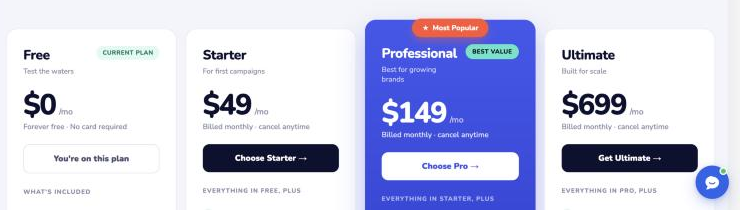
| Plan | Monthly | Annual | Platform fee on offers |
|---|---|---|---|
| Free | $0, no time limit | $0 | 25% |
| Starter | $49 | $33 a month, $396 billed yearly | 20% |
| Professional | $149 | $104 a month, $1,249 billed yearly | 15% |
| Ultimate | $699 | $500 a month, $5,999 billed yearly | 3% |
The right-hand column is the one to read first, and it is the number most comparisons of this category leave out. The platform fee is charged on top of the price you agree with the creator, at checkout, and it falls from 25% on Free to 3% on Ultimate. On a $2,000 monthly creator spend that is $500 a month on Free against $60 on Ultimate, which means the subscription can pay for itself purely on fees well before you run out of plan limits.
What Each Plan Actually Allows
Plans are limited by volume rather than by feature, and the limits reset monthly. Paid plans reset on the anniversary of your subscription date; the Free plan resets on the first of the calendar month.
| Limit | Free | Starter | Professional | Ultimate |
|---|---|---|---|---|
| Campaigns held at once | 1 | 2 | 3 | Unlimited |
| Influencer invites a month | 5 | 50 | 500 | 50,000 |
| Team seats, including the owner | 1 | 1 | 3 | Unlimited |
| Username reveals a month | 5 | 50 | 100 | 6,000 |
| Extra reveal, from wallet | $1.00 | $0.75 | $0.75 | $0.50 |
| Advanced analytics reports a month | 3 | 30 | 100 | 1,000 |
Two details worth knowing before you pick a tier. Campaigns waiting for admin review count against your campaign allowance, while drafts, paused and rejected campaigns do not. And inviting a whole favourites list counts every influencer in it against your monthly invite allowance, which is the most common way a brand reaches the limit without noticing.
Creator fees sit outside all of these, which is the point most worth stating clearly in any Ainfluencer review. What you pay the creator is negotiated with them and held in escrow; the platform fee above is separate and is what Ainfluencer charges you. The free tier genuinely allows posting campaigns and paying creators through escrow without a subscription, at the cost of the highest fee rate and the tightest limits.
Ainfluencer Fully Managed Services
For brands without someone to own the channel internally, the managed option covered in this Ainfluencer review hands execution over entirely: sourcing, outreach, briefing, negotiation, content quality control, and reporting.
Pricing runs as a one-month pilot at $2,900 flat, then $1,500 monthly for 25 influencers, $2,500 for 75, or $3,000 for 150, with a three-month minimum after the pilot. Full detail sits on our fully managed influencer marketing page.
The honest framing for the pilot: it exists so a brand can test whether the channel works for them before committing to a longer arrangement, and a month is enough to learn that.
Ainfluencer Review of Fit: Who It Suits and Who It Does Not
It suits brands wanting volume across many smaller creators rather than a few large placements, which is the economic case set out in our guide to micro influencer marketing. It suits brands wanting to test the channel without a retainer, since the free tier makes that possible. It suits ecommerce and consumer products where content converts directly. And it suits brands running seeding programmes at scale, covered in our overview of product seeding.
It suits less well in several genuine cases. Brands needing celebrity-tier talent should work with talent agencies, since that market runs on relationships rather than marketplaces. B2B companies will find creator supply thinner in most professional niches. Brands wanting a single strategic partner to own positioning as well as execution are describing an agency rather than a platform, and our roundup of the best influencer marketing agencies is the better starting point. And brands with no internal owner and no budget for managed services will struggle, because self-serve platforms require someone to actually serve themselves.
Ainfluencer Review From the Creator Side
The creator side of any Ainfluencer review matters, because a marketplace only works if both sides show up.
- Free to join and use, with no subscription for creators
- Payment protection through escrow, which removes the most common risk in brand deals
- Set your own rates rather than accepting posted offers
- Inbound campaign matching, so brands find you rather than requiring constant pitching
- Negotiation in-app with terms recorded, which protects both sides in a dispute
Creators evaluating whether to join should read our checklist of what brands look for in influencers, since profile quality determines how many campaigns you get matched to. Any partnership secured through the platform must be disclosed under the FTC disclosure guidelines, which applies to gifted product as well as paid work.
Ainfluencer Review of Campaign Types Supported
The platform supports the main creator marketing formats rather than specialising in one, which matters because most brands eventually run several at once.
Paid sponsored posts are the standard format: agreed deliverables, a negotiated fee, escrow-protected payment. Product seeding sends product without a guaranteed post, which is the cheapest way to discover which creators actually convert before committing budget. Affiliate arrangements pay commission on tracked sales rather than a flat fee, which suits brands wanting performance-only cost. And ongoing partnerships retain creators across months rather than single posts, which is where association genuinely compounds.
The practical sequence most successful programmes follow is to seed widely first, pay the creators who performed, and retain the small number who consistently drive results. Our guide to influencer marketing campaigns covers how those formats differ on cost and outcome, which is worth reading before deciding what to run.
One caveat worth stating in an honest Ainfluencer review: the platform handles sourcing, negotiation, and payment well, but it does not write your strategy. Deciding what to say, to whom, and why remains your work, or the managed team’s if you buy that. Brands expecting a platform to supply positioning will be disappointed by any marketplace, not just this one.
How to Evaluate Any Platform in This Category
Rather than asking you to take this Ainfluencer review at face value, here are the questions worth asking of any platform including this one. What does the subscription cost and what sits outside it? Are creator fees separate? How is payment protected if a deliverable fails? Can you test the platform without committing to an annual contract? How many creators actually exist in your specific niche and country, rather than in the headline database figure? And what happens when a campaign goes wrong?
That last question separates platforms more than any feature comparison. A marketplace with no dispute process transfers all the risk to whichever party moved first, which is exactly the problem escrow exists to solve.
Conclusion
The short version of this Ainfluencer review: it is a marketplace rather than an agency, the free tier genuinely allows running campaigns and paying creators, escrow removes the trust problem that makes first-time collaborations difficult, and managed services exist for brands with nobody to own the channel internally. It fits volume programmes across smaller creators considerably better than celebrity placements or B2B niches. Since testing costs nothing, the sensible approach is to run one small campaign and judge from your own results rather than from anyone’s review, including this one.
FAQs
Is Ainfluencer actually free?
The free tier allows posting campaigns, searching creators, messaging, and paying through escrow with no subscription. Paid plans from $49 monthly add volume and advanced features. Creator fees are always separate.
How does escrow protect both sides?
The brand deposits funds before work begins so the creator knows payment is committed, and funds release only once the delivered content is approved.
How large is the creator database?
Around 5 million influencers in total, with more than 900,000 active and verified. The figure that matters for you is how many exist in your specific niche and country.
What does the managed service cost?
A one-month pilot at $2,900 flat, then $1,500 monthly for 25 influencers, $2,500 for 75, or $3,000 for 150, with a three-month minimum after the pilot.
Who should not use it?
Brands needing celebrity-tier talent, most B2B companies, and brands wanting a strategic partner to own positioning rather than a platform to execute on.