Running a profitable HVAC business today isn’t just about doing great installs and repairs; it’s about keeping a steady flow of new customers coming in. It’s always essential to know how to generate HVAC leads.
In this blog, we’ll break down what HVAC lead generation actually means, why it’s so critical for year‑round revenue (not just during peak seasons). We will also explain practical B2B lead generation strategies that can help you bring in more leads.
Let’s learn some tricks to grow your HVAC business.
What Is HVAC Lead Generation?
HVAC lead generation involves attracting individuals who require heating, ventilation, and air conditioning services. It’s about converting their interest into genuine inquiries, such as calls, form submissions, or requests for quotes.
In practice, it means using marketing activities (online and offline) to:
- Get in front of homeowners or businesses searching for HVAC help (repairs, installs, maintenance, air quality issues).
- Capture their attention (ads, website, Google profile, referrals, etc.).
- Make it easy for them to contact you and become a “lead” your team can follow up with.
Residential vs. Commercial HVAC Leads: Understanding the Difference
HVAC lead generation for both residential and commercial lead groups is similar, but there are slight differences to consider. First, let’s explain each lead:
- Residential HVAC leads are homeowners or tenants looking for installs, repairs, or maintenance in houses, apartments, or small residences.
- Commercial HVAC leads are businesses, property managers, or organizations needing HVAC services for offices, retail, warehouses, industrial sites, or large buildings.
Their key differences are:
| Differences | Residential leads | Commercial leads |
| Deal size and revenue | Lower-ticket (single system install, repair, seasonal tune-up) but come in higher volume. | Higher-ticket (multiple systems, rooftop units, ongoing service contracts) and can reach large contract values per client. |
| Decision-makers | Decide quickly/ the sales cycle is short | Stakeholders (facility manager, finance, ownership), formal bids or RFPs/ longer sales cycles |
| Lead volume | More abundant (especially in hot/cold seasons)/ day‑to‑day cash flow | Are fewer, but each one can turn into multi-year service and maintenance agreements with high lifetime value. |
| Service type and complexity | Smaller/ more standardized, so services are more routine and faster to complete. | Larger/ modular, and more complex (zoning, controls, code requirements), so projects are longer and more specialized. |
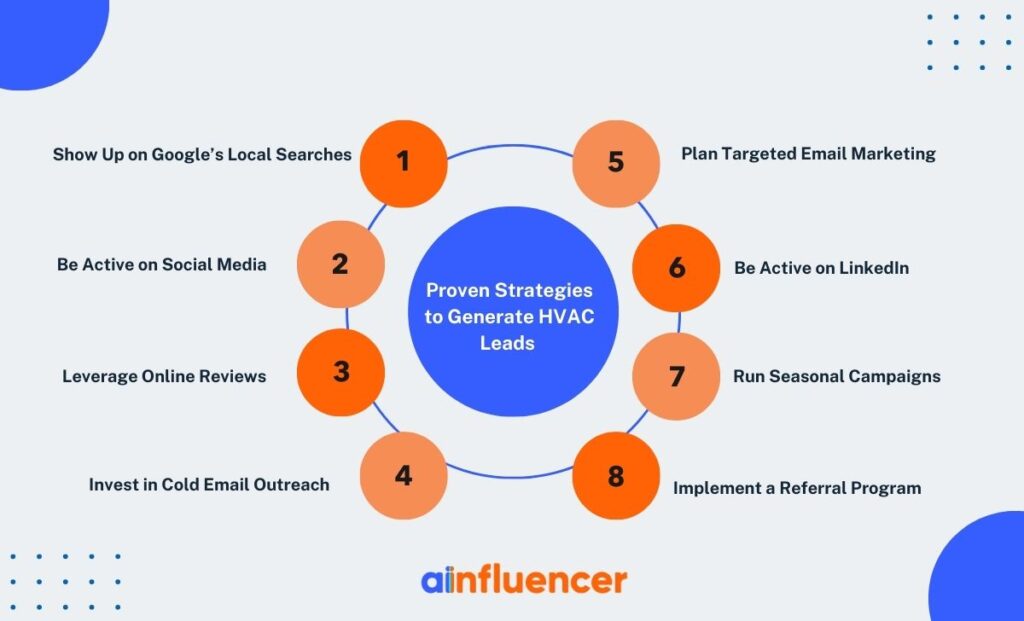
8 Proven Strategies to Generate HVAC Leads
Whether you have just started your business or are a professional in this industry, you need to follow some strategies to not only bring in more leads but also keep the current customers.
#1 Show Up on Google’s Local Searches
Generating HVAC leads through local SEO is one of the most effective, long-term strategies.
Therefore, you should focus on dominating local Google results so homeowners and companies find and call you when they search “HVAC near me” or “AC repair + your city.”
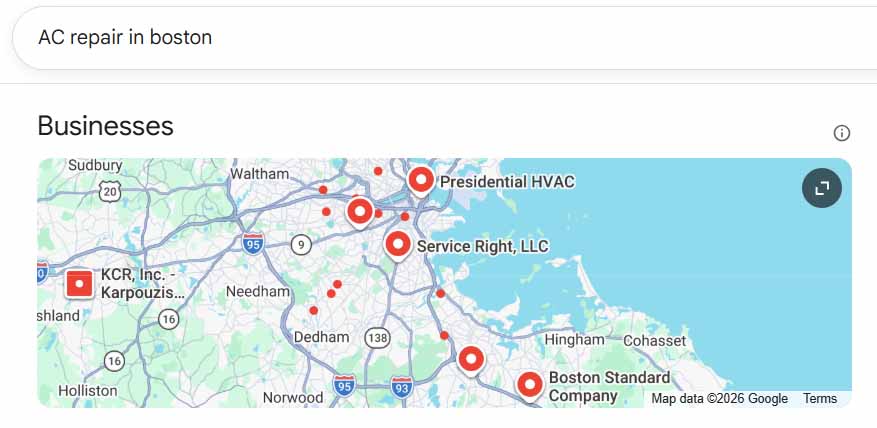
To appear on Google for local searches, you should:
- Optimize your website to convert.
- Claim and fully complete your profile on Google My Business.
- Point out your location on Google Maps.
- Make sure your business name, address, and phone (NAP) are consistent across your website and directories.
#2 Be Active on Social Media
Focus on platforms where your audience spends time: Facebook (local homeowners 35+), Instagram (visual proof and younger audiences), TikTok (viral awareness for future buyers), and YouTube (long-form educational content). These drive the majority of social leads for HVAC.
Whether your target audience are businesses or homeowners, select an influencer marketing agency for B2B influencer marketing or other influencer campaigns.
- Target relevant influencers: Focus on local influencers. For example, if you provide services in Spain, you can look for Spanish real estate influencers. Avoid big celebrities; micro influencers deliver higher trust for HVAC.
- Collaboration ideas: Sponsor content like “Home comfort tips with [Your Company]” videos, affiliate promotions (e.g., commissions on referrals for new systems), or co-created posts showcasing installs (ductless mini-splits for aesthetics). Offer free tune-ups or discounts for shoutouts.
- Strategies for success: Start small: Reach out via DM/email with clear value (e.g., free service for content). Use affiliate codes for tracking. Measure ROI via unique links/codes or increased inquiries post-campaign.
#3 Leverage Online Reviews
Reviews act as powerful social proof, directly influencing customer trust. Having good reviews and ratings can also boost local SEO rankings. Businesses with 4.7+ stars, 100+ reviews, and consistent fresh ones dominate searches like “HVAC repair near me” and convert more leads.
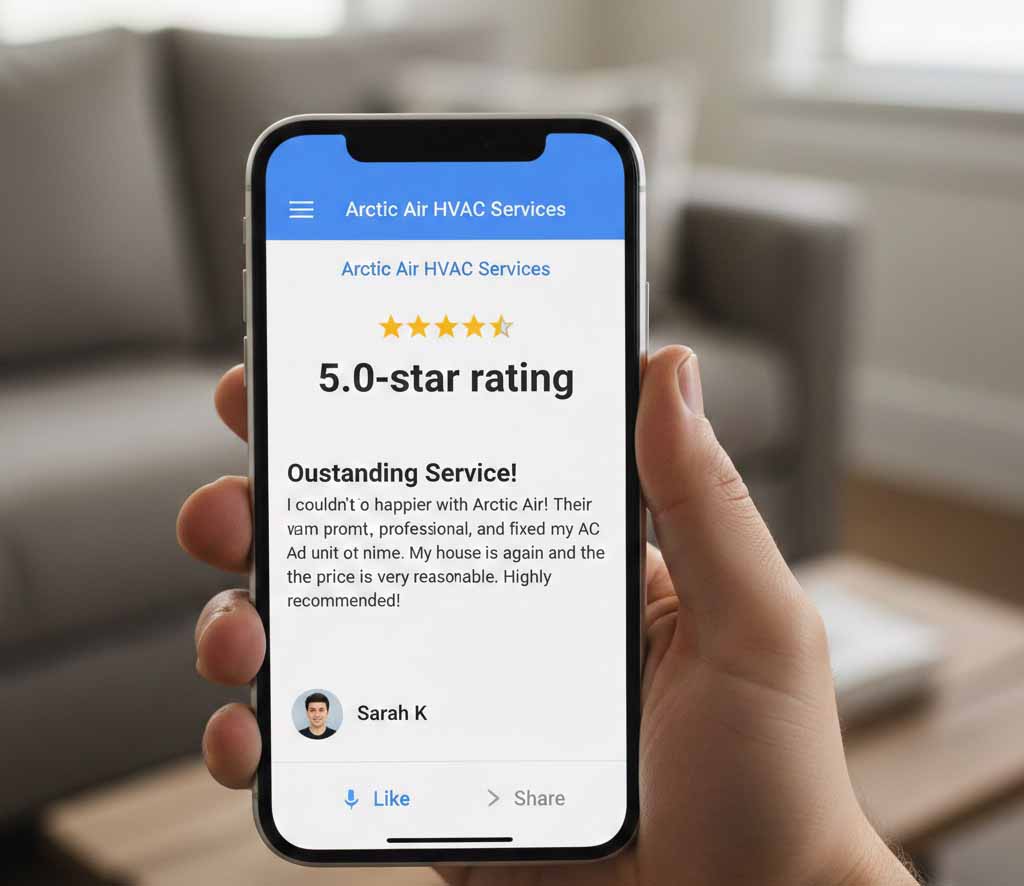
Here are some tips that can help you gain better reviews:
- Systematically ask for reviews after every job.
- Reply within 24 hours.
- Thank positive reviews personally.
- Apologize and offer solutions for negative reviews.
- Embed positive reviews on your website.
- Showcase your ratings on your social platforms or emails.
#4 Invest in Cold Email Outreach
Most HVAC companies think they should only focus on SEO and let their customers find them on Google. Although it’s a ‘must’ for all businesses to work on their SEO, if you are a startup and new to this business, putting all your efforts into this strategy won’t bring any leads.
You need to reach out to your potential customers, too, especially if you provide services to other businesses. That’s why cold emailing is still helpful.
However, there is another problem that may make you avoid using this strategy: you need to have an email list. And even with a complete list and automation cold email tools, it’s still possible that the recipients don’t receive your email, due to crowded inboxes or spam filtering.
That’s why you need to think about a new and modern cold outreach method called contact form marketing. Read more about the differences between cold email marketing vs contact form marketing.
What is Contact Form Marketing?
Finding your target business’s websites is much easier than finding the emails of their decision makers. Most websites have a contact form, which you can use to send your intro message.
Now you may think what a hard job! Don’t be scared! There is always a solution for every marketing process. In this case, a contact form marketing tool, like Bulk Cold Outreach with AI Contact Form Submission Chrome extension, can be helpful.
What is the Bulk Cold Outreach Tool?
If finding contact forms on the websites, filling the fields, and submitting them manually seems an exhausting process for you, add this extension to your Chrome and let it do the job.
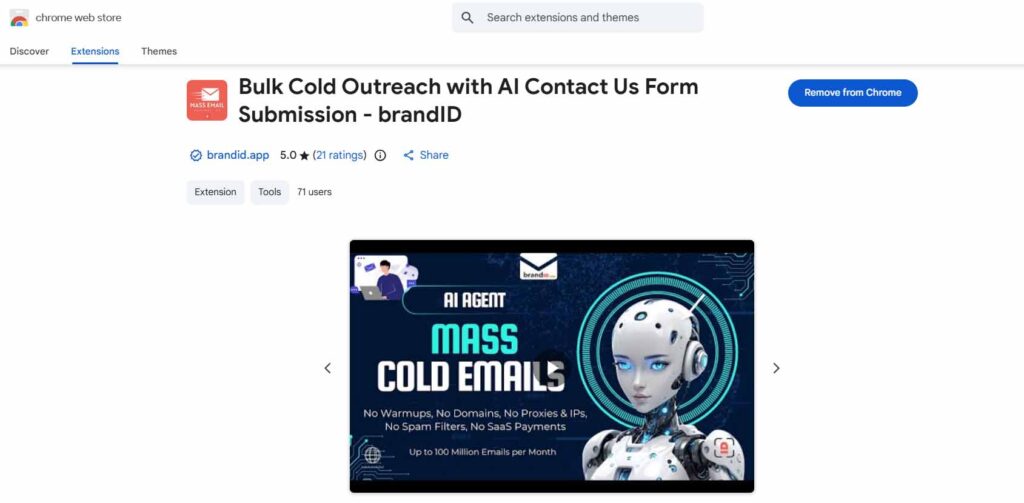
Bulk Cold Outreach with AI extension is designed to:
- Search each website for a valid contact form,
- Write your message,
- Submit it in just a few seconds.
This extension overcomes obstacles by:
- CAPTCHA resolving: It can automatically resolve the CAPTCHA available on forms. So, you can ensure your message is sent.
- Language detection: If a website is in another language, this tool understands the language of the form and easily fills it. Now it supports 12 languages.
- Spam Bypass: Since your pitch is being sent via the contact form on the website, your email won’t land in any spam inbox. Contact forms on the websites are usually linked to inboxes that decision makers check.
- Personalization: You don’t want to send generic emails to all businesses. For some outreaches, you may need message personalization. This tool allows you to personalize your email for each website.
- A/B testing: You don’t know what type of message is more attention-grabbing. So, you can define two messages with the same subject and let the tool send them randomly to see which gets more replies.
- 100% deliverability: The extension guarantees all your emails are delivered to the website’s contact forms’ inboxes. You will be informed if a contact form is not valid or deliverable.
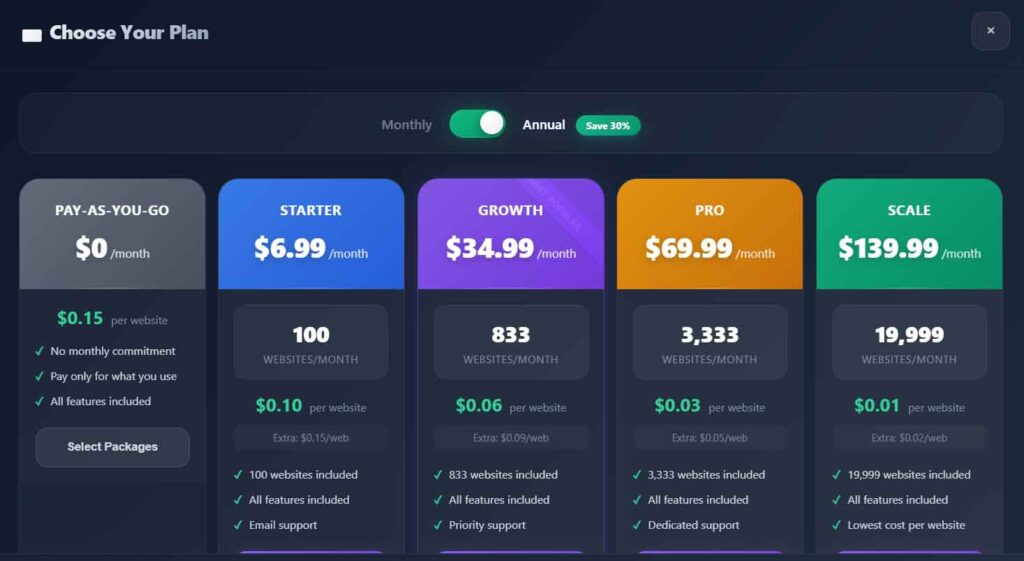
If you haven’t used such a tool yet, you can install it now and test it on 30 websites for free. After that, you can purchase any plans that suit your budget and needs.
#5 Plan Targeted Email Marketing
Email marketing can be a great investment for HVAC leads, often bringing in $36 to $40 for every $1 spent. It’s the best method to nurture your past customers and remind them you still exist.
However, email marketing is a bit tricky. Because if you overdo it, you can miss great opportunities by looking spammy. So, it’s better to focus on opted-in subscribers to avoid spam flags and low engagement.
You should also note that generic bulk emails get ignored. On the other hand, targeting turns emails into lead magnets. So, let’s create a group and a target for your email lists:
- Past customers: Highest conversion: Send maintenance reminders (e.g., “It’s been 6 months since your last tune-up—book now?”), birthday/service anniversary offers, or upsell emails (“Upgrade to energy-efficient system—save on bills”).
- Prospects/leads: Nurture with drip sequences: Welcome series (tips + intro offer), educational content (“How to Choose the Right HVAC”), then promotional (“Limited-Time Free Estimate”).
- Seasonal segments: Summer: AC prep/checks; Winter: Furnace/heating; Off-season: General maintenance or energy-saving tips.
- Personalization tips: Use first name, reference past service (“Your Bryant system…”), or location (“In [City], summer heat is coming—here’s how to stay cool”).
#6 Be Active on LinkedIn
Many commercial decision‑makers (facility managers, property managers, builders, and business owners) already spend time on LinkedIn. That’s why this platform is the best option to get in front of high‑value B2B prospects with low “noise” compared with other social platforms.
What to do:
- Create a page for your company with complete information, e.g website, phone number, and location.
- Share useful content (case studies, before‑and‑after projects, energy‑saving tips) to position your company as an expert, and build trust over time.
- Join industry groups and answer the questions.
- Connect directly with the right people at the right companies.
- Send them a cold message to start a conversation and find a way to introduce your business.
- Run highly targeted ads.
#7 Run Seasonal Campaigns
Running seasonal campaigns increases HVAC leads because you’re matching your offer to what homeowners urgently care about at specific times of year (heat in winter, cooling in summer, “tune‑up” before extremes).
- Create one main message per season (headline, short description, clear call‑to‑action, and deadline). Example: “Winter Furnace Check‑Up – 20% Off This Month Only. Call before December 30.”
- Use urgency words (“this month only,” “before the first heatwave,” “before the first snow”) to push people to act now, not later.
Where to promote:
- Website: Add seasonal banners and landing pages for each promo (e.g., /ac-tune-up-spring) with a quick form and click‑to‑call number.
- Google Ads / PPC: Switch keywords and ad copy by season (AC in summer, furnace in winter) and raise budgets when demand peaks.
- Email and SMS: Send reminders to past customers with the seasonal offer and a direct booking link or phone number.
- Social media: Post graphics and short videos about the seasonal deal, plus maintenance tips tied to that weather (heatwaves, first freeze, etc.)
#8 Implement a Referral Program
Referred customers convert faster, spend more, and build trust through word-of-mouth. For this reason, creating a referral program is a highly efficient and affordable method for getting good HVAC leads.
Here are some tips that can help you generate quality HVAC leads with referrals:
- Collaborate with non-competing businesses (e.g., plumbers, electricians, real estate agents, or hardware stores) for mutual referrals, offering commissions, shared discounts, or co-branded perks. Expands reach through industry networks.
- Rewards escalate with more referrals (e.g., $25 gift card for the first, free inspection after three, $50+ credit or upgrade after five). Great for motivating repeat referrers and building loyalty.
- Both the referrer and the new customer get a service credit or discount (e.g., $50–$100 off next maintenance, repair, or install). This is popular for encouraging mutual value and works well for maintenance plans or tune-ups.
Bottom Line
Generating HVAC leads requires a balanced, multi-channel approach that combines free, long-term foundations. Therefore, based on your budget and goals, consider mixing the mentioned strategies. Focus on optimizing your Google Business Profile, dominating local SEO, and aggressively building online reviews.
Add targeted Google Ads, contact form marketing, social media engagement, email nurturing, and a well-executed referral program to gain better results.
By consistently implementing these proven strategies and focusing on high-intent, trust-building efforts, HVAC lead generation will be much easier than before. Start small, track your results, and scale what works; your next busy season could be your best yet.
FAQs
You track key metrics such as number of leads per month, cost per lead, booking rate (leads that turn into appointments), close rate (jobs sold), and revenue per job. If these numbers are improving over time, especially lower cost per lead and higher close rate, your lead generation is becoming more effective.
You can refine your targeting (service area, ideal customer, services), improve your messaging to focus on value instead of just price, and make your offers specific (e.g., system replacements, IAQ solutions, maintenance plans). Adding clear qualifications on forms or phone scripts and focusing on channels where people have strong purchase intent (Google Search, referrals, existing customers) also increases lead quality.