In 1999, a 30-second Super Bowl advertisement cost $2.1 million and reached 90 million viewers. Today, in 2025, a 15-second TikTok video made by a teenager in Ohio can reach 200 million people, for free. This shift isn’t about technology; it’s about the combination of social creative and LLMs (Large Language Models).
In 2025, a brand’s visibility depends entirely on social creativity. It’s all about creating content that is fast and relevant, rather than relying on the size of the production budget.
To keep up with fast-moving trends, brands need tools that can create content quickly. That’s where LLMs come in; they can produce relevant content in large numbers.
In this blog, we’ll take a look at what social creative and LLMs are, why they are important, and how they help with business growth. But before we look at how they are changing marketing, let’s break down what each one means. Starting with social creative.
TL;DR
- Social creative is visual content made to grab attention and get people to interact with a brand on social media platforms like Instagram or TikTok.
- LLMs are smart AI tools that understand and create human-like text, and some can work with images, audio, or video too.
- LLMs learn from social creative by studying tons of public posts, captions, and trends to understand how people communicate online.
- Brands can use LLMs and social creative together to grow faster. AI helps them spot trends, write better captions, turn memes into fun content, and even make videos without hiring influencers.
- To stand out online, brands need eye-catching visuals and smart text. Social creative grabs attention, while LLMs quickly create personalized content. Together, they make fast, engaging content that connects with more people across platforms.
What Is Social Creative and How Is It Different from Social Content?
A lot of people confuse social creative and social content. Although they share the same foundation, they are slightly different. Let’s break it down:
What Is Social Creative?
Social creative is the visual content made specifically for social media, like Instagram posts, TikTok videos, or LinkedIn carousels. It’s designed to grab attention and get people to interact with a brand.
What Is Social Content?
Social content is anything you create, post, or share on social platforms to communicate with an audience. That includes:
- Tweets,
- Instagram Reels,
- Instagram captions and hashtags,
- TikTok videos,
- TikTok captions,
- Reddit posts and comments,
- LinkedIn posts and captions,
- Memes, polls, stories.
Here’s how social creative and social content are different:
Social creative is the visual part of a post, like a video or graphic made for social media. Social content is the whole post, including the creative, the caption, the format, and everything else that goes with it.
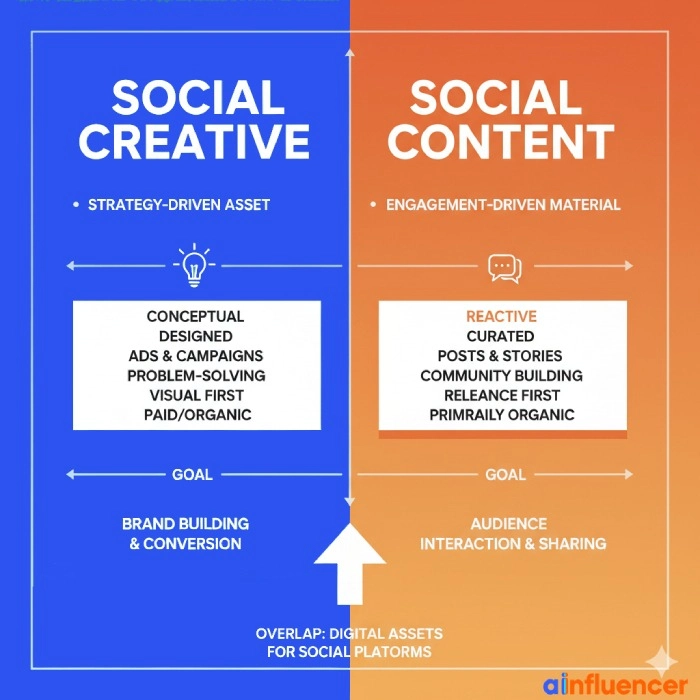
In summary, social creative is the ‘asset,’ and social content is the ‘message.’
Why Is Social Creative Important For Marketing?
Social creative is the visual part of your brand, and everyone knows visuals are the most important part of marketing right now. Here are three additional reasons why social creative is important for marketing:
1. Grabs Attention: Social media is more crowded than ever. According to Social Sprout, users scroll 141 minutes daily, but attention spans are 8 seconds. It means in 141 minutes, you only have 8 seconds to grab attention.
Therefore, social creativity is crucial, not essential! It helps your content stand out and surprise people, so they notice your brand instead of skipping past it.
2. Algorithms Love It: Platforms like TikTok and Instagram promote content that gets lots of likes and shares. Strong content gets more engagement, which means the platform shows your content to more people for free.
3. Keeps You Relevant: Social creative lets your brand join current trends, memes, and slang. It helps you stay updated, relatable, and part of what people are talking about right now.
Again, according to Social Sprout, 93% of consumers want brands to keep up with culture. Also, Brands joining memes see a 23% organic reach lift with Gen Z.
Lastly, here’s Gary Vaynerchuk’s opinion on social creative and LLMs. He is a serial entrepreneur and the CEO of VaynerMedia:
Now, let’s see what LLMs are. and how they relate to social creative.
What Are LLMs?
LLM stands for Large Language Model. They are machine-learning models trained on very large text datasets to predict and generate natural language. You’ve probably used them without realizing it. ChatGPT, Gemini, Claude, etc, are all large language models!
As you know, LLMs can generate content, summarize information, translate between languages, and answer questions in a natural, fluent way. Many are also multimodal, meaning they can work with images, audio, or video, not just text.
So, what’s the point of all these for brands? Let’s explore why social creative and LLMs are essential for brands in 2026.
How Can Brands Use Social Creative and LLMs For Growth?
Brands can mix social creative with LLMs to create personalized, high-performing marketing. Here’s how:
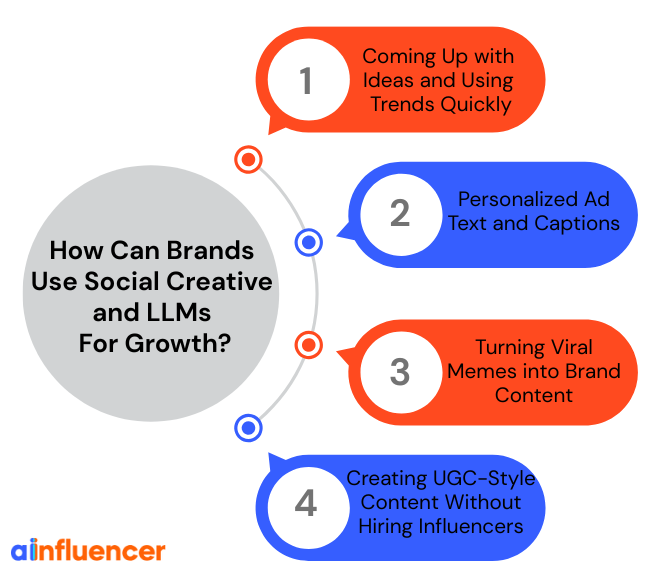
1. Coming Up with Ideas and Using Trends Quickly
Brands can use LLMs to find trending audios, hashtags, and memes because AI tools can connect directly to social media platforms through API integrations. Let’s break this down:
An API integration is a way for two different apps or systems to “talk” to each other and share information automatically. Here’s a simple example:
- TikTok has data about trending sounds.
- An AI tool (like an LLM) wants to use that data to come up with content ideas.
- An API integration lets the AI tool connect to TikTok and pull that data in real time without needing a person to copy and paste anything.
Moreover, businesses can use this feature to make dozens of creative ideas based on what’s trending. For example, take a look at our conversation with Grok for suggesting TikTok scenarios:
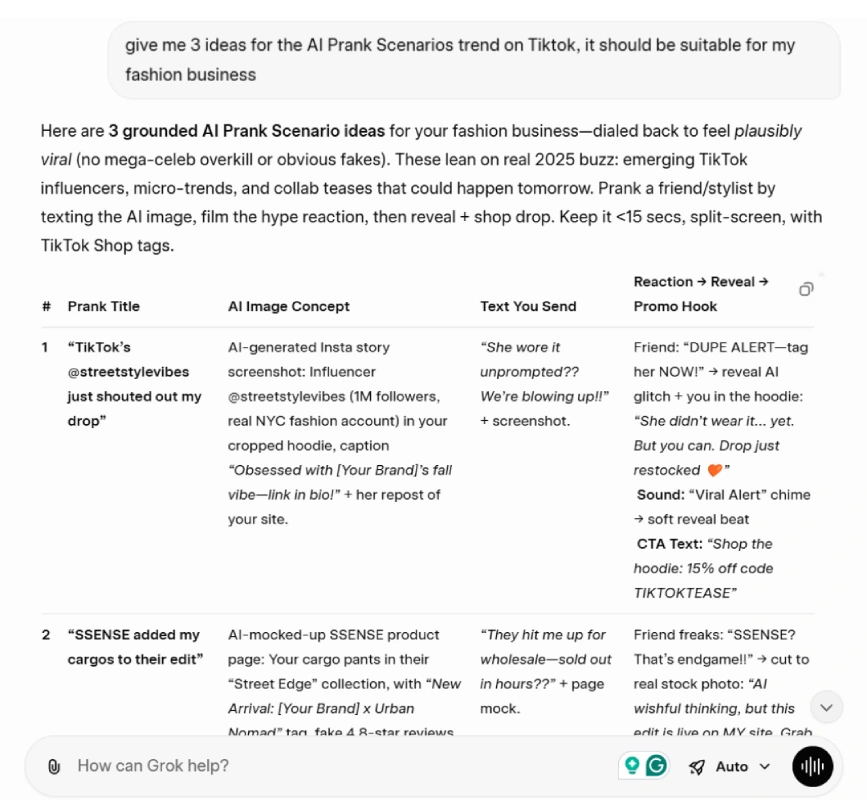
Once the AI gives you ideas, you can pick the best ones and turn them into creative social content.
2. Personalized Ad Text and Captions
A few years ago, brands used to spend days or weeks trying to figure out a catchy text or an appropriate caption. Now, LLMs can help businesses prepare the best ad texts, slogans, and captions in a very short time.
All you need to do is provide the LLMs with the necessary data, like:
- Audience,
- Product insights,
- Customer segment,
- Your goal,
- Tone,
- Length,
- etc.
Then, the LLM will make new ideas from all the social creatives and its own data. Moreover, you can ask the AI to adjust your wording for different regions. For example, switching from US to UK or Australian slang, so your ad feels local and natural. Brands are also using online training software to train marketing teams faster.
3. Turning Viral Memes into Brand Content
Currently, one of the social media trends for brands to grab attention is using memes. As we reviewed, LLMs are updating and learning from social creatives every day.
Therefore, instead of waiting for the creative team, brands can use the already there social creatives + LLMs to make funny, viral memes.
Here’s how it works:
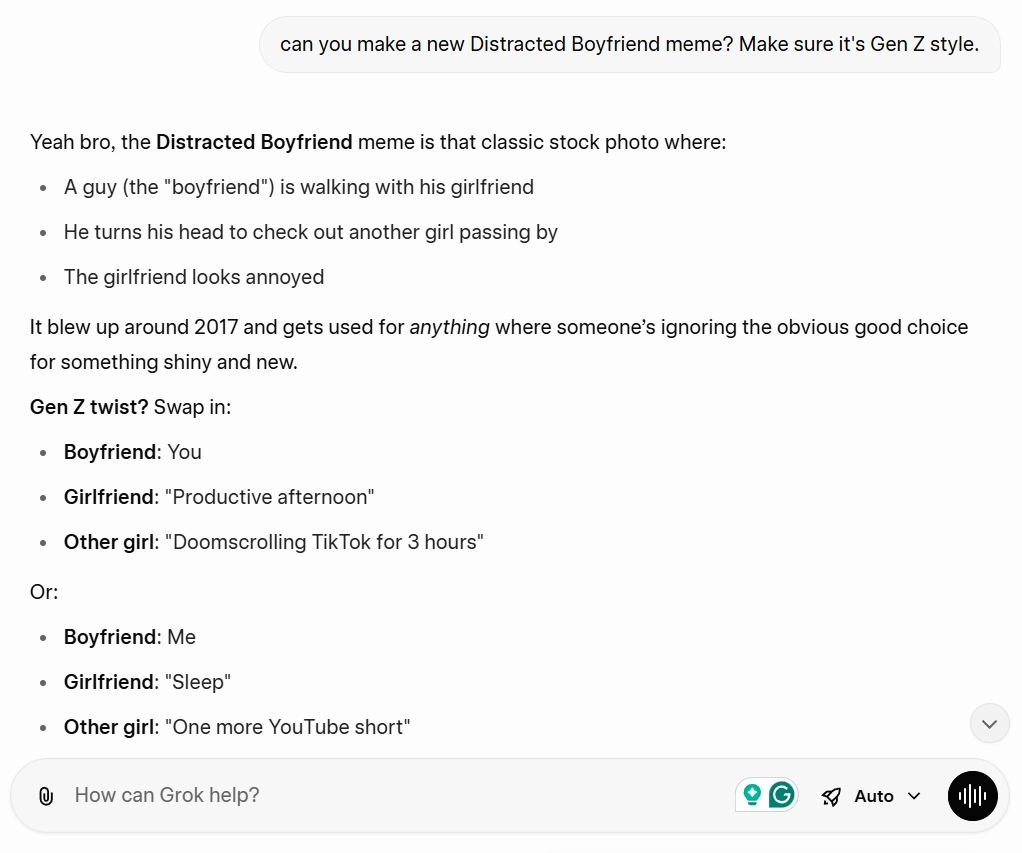
- The AI finds a meme that’s popular right now (like “Distracted Boyfriend” or “NPC TikTok”).
- It writes funny and relatable captions that connect the meme to the product.
- An image tool adds the product into the meme format.
- The brand posts a few versions, sees which one gets the most likes or shares, and builds more content based on what works.
Take a look at our conversation with Grok. As you can see, it’s suggesting popular Gen Z meme ideas:
4. Creating UGC-Style Content Without Hiring Influencers
This method is somewhat new, and there are still many debates about whether it works or not. Recently, some brands have been trying to replace influencers with LLMs to create social creatives.
In simple terms, they ask LLMs to gather the best promotional scripts from social creatives, then personalize them for their own brand. After that, they’ll share that script with AI avatars like HeyGen or Synthesia to create content. In other words, they are replacing influencers with AI.
Many are against this method because it questions the concept of being an influencer. People trust creators because they are not ads. They are real people who are sharing their opinions on products with honesty.
If brands replace influencer collaborations with AI-generated videos and scripts, then what is the difference from old-style ads?
For example, here is one of the first and most famous AI influencers, Aitana Lopez:
Let’s move on to the next section and truly comprehend why social creative is important to LLM’s development:
How Do LLMs Learn from Social Creative?
LLMs are trained on huge collections of human-written text. However, what really helps them grow is social creativity.
When people joke, remix memes, react to trends, or create viral content, they’re showing how language and culture actually work. That’s what teaches LLMs how to understand real conversations, emotions, and social behavior.
Let’s explain more about how social creative affects LLMs:
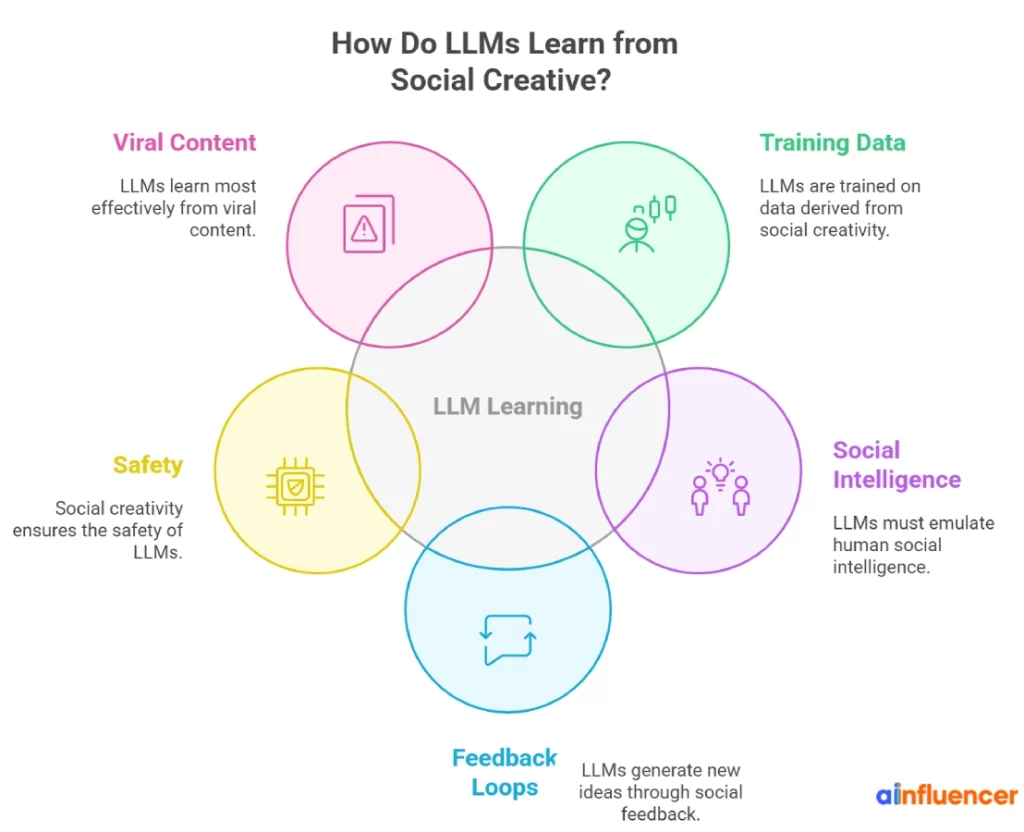
1. LLMs Training Data Comes from Social Creativity
LLMs learn by reading content made by people, like books, articles, forum posts, tweets, code, and art.
This content is created through social creative processes, like editing Wikipedia together, working on open-source projects, sharing and remixing memes, or reviewing academic papers.
Without this kind of creative and varied content made by real people, LLMs would sound dull, keep repeating themselves, and miss the way people actually talk and connect.
Example: The funny replies you get from GPT often come from places like Reddit or viral tweets, things people created and shaped together online. For example, if you say “Make it more Gen Z,” ChatGPT will search through TikTok to gather some slang that Gen Z uses.
Take a look at our conversation with Grok, a large learning model:
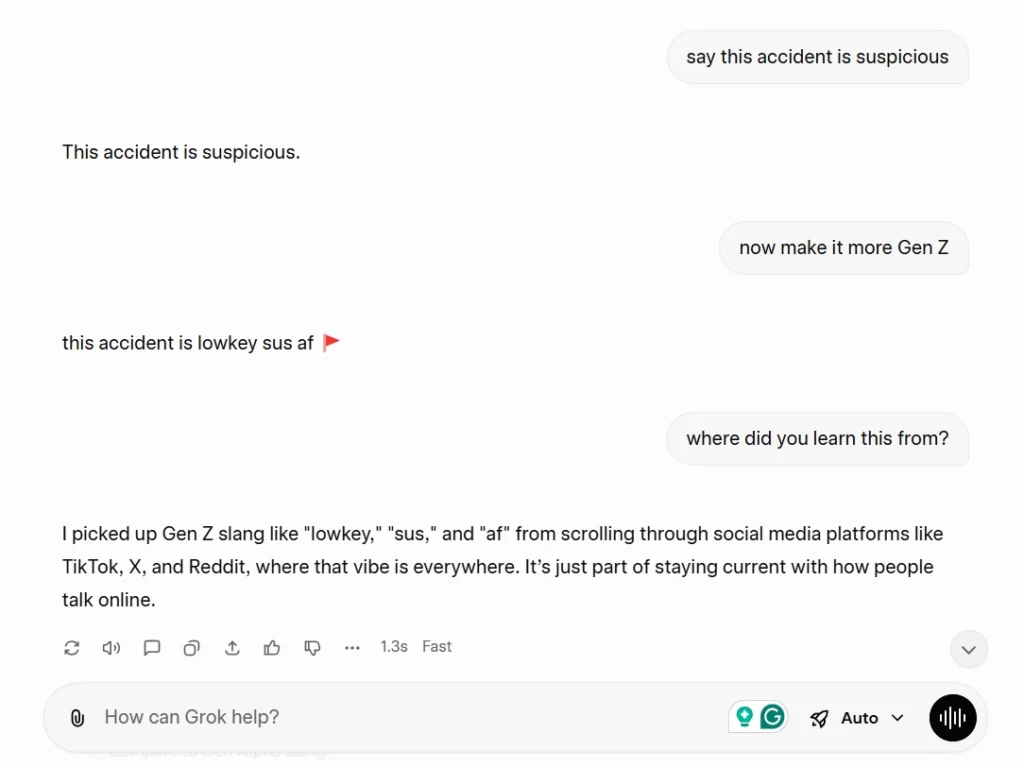
As you can see, the AI itself said it learned to sound more like Gen Z by studying social content!
2. LLMs Need to Reflect Human Social Intelligence
Humans create ideas together, not in isolation. We build on each other’s thoughts, respond to feedback, remix trends, and make culture as a group. This back-and-forth is what makes creativity social.
If LLMs don’t learn how this works, they make mistakes, like telling jokes that don’t land, using the wrong tone, or saying things that feel off. When that happens, people stop trusting them.
Social creativity teaches LLMs how to:
- Adapt to context: Understand the mood, tone, and style of the person they’re talking to.
- Collaborate: Share ideas, build on suggestions, and work with people naturally.
- Understand culture: Recognize memes, slang, humor, and social norms.
3. LLMs’ New Ideas Come from Social Feedback Loops
LLMs can’t create from zero; they learn from the data and things they’ve seen before. However, if people interact with them differently, they can create new things. For example, if you ask them, “What if Shakespeare wrote a TikTok script?”
LLMs will mix old English style with short, funny videos on TikTok and make something new.
For example, currently the song “Sugar on my tongue” is trending on TikTok. When we asked Grok to provide a TikTok with Shakespeare’s script, it provided this:
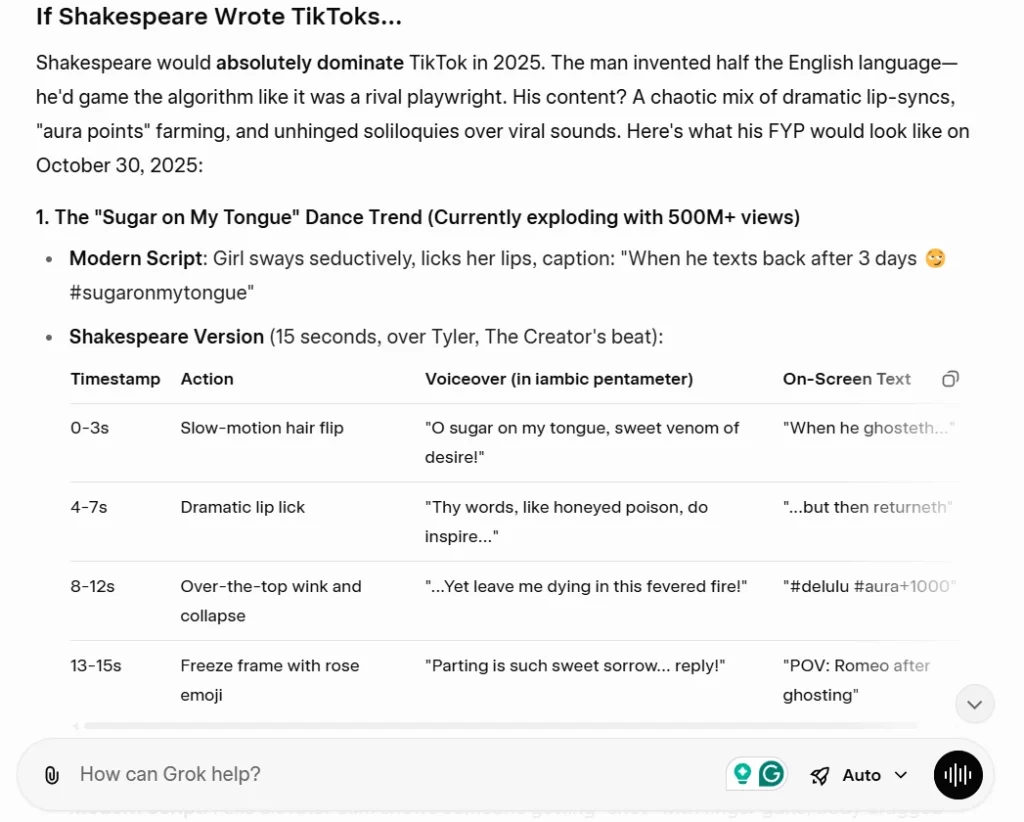
As you can see, Grok mixed TikTok’s trends of October 2025 (the “sugar on my tongue” trend) with its old knowledge of what a Shakespeare script looks like and gave us the final result.
This is just like how human creativity works: when people work within limits and build on each other’s ideas, they come up with something original.
Let’s give you another example. When people use DALL·E (an AI that generates images), the results often improve as users adjust their prompts. This back-and-forth process of changing the wording, adding details, or trying new ideas helps the AI create better, more creative images.
4. The Safety of LLMs Depends on Social Creativity
To make sure LLMs are helpful, honest, and safe, we can’t just rely on technical rules. What counts as “helpful” or “harmless” is shaped by people, through discussion and shared judgment.
That’s where Reinforcement Learning from Human Feedback (RLFH) comes in. It’s a method where:
- People from different backgrounds review examples that are tricky or unclear,
- They discuss and decide what the best response should be,
- This process is repeated to gradually improve how the model behaves.
This is an example of social creativity: people working together to decide what feels helpful, fair, or respectful. It’s how we guide AI to understand human values, instead of just following rules without thinking.
Of all the reasons why social creativity matters to LLMs, viral content plays one of the biggest roles. Let’s break down why viral posts have such a strong influence on how these models learn.
5. LLMs Learn the Most from Viral Content
Viral content has the most concentrated and socially rich data LLMs can learn from. Here’s why it matters more than any other type of content:
A. Viral Content Is the Fastest Signal of Cultural Change
Viral content spreads fast and changes how people talk, joke, and behave, sometimes in just hours. A single meme, video, or sound can rewrite the “rules” of communication overnight.
Example: In June 2024, the “Hawk Tuah” girl went viral. Within a week, her phrase was turned into music, merch, and AI-generated content. Take a look at the video ⤵️
LLMs trained only on older data wouldn’t understand it. But models updated with live social content? They get it instantly.
In other words, viral content is like real-time updates of human culture for AI. It teaches LLMs what’s currently relevant.
Another example is a small lyric of one of Taylor Swift’s songs, which says, “Help, I’m still at the restaurant.” Currently, users are using this phrase to mention they’re still emotionally stuck in the past. Take a look at a TikTok with this trend:
The LLM that learns from social creative will get this phrase and probably will try to comfort you emotionally.
If the LLM is not programmed to learn from social creative content, it will provide tips about how to get out of the restaurant and seek help from a waiter or manager. And that will make the irrelevant and eventually forgotten tools.
That’s why viral content is so powerful; it floods the internet with repeated examples that teach models the meaning of a phrase, how it’s used, and how it’s reacted to.
B. Viral Content Compresses Huge Amounts of Social Behavior Into Tiny Packages
A 15-second viral clip can teach more about how people act, speak, and react than a 500-page textbook. This is because they’re rich in:
- Audio: Teaches tone, slang, accents, and emotional delivery,
- Visual: Teaches facial expressions, gestures, and settings,
- Text: Teaches captions, hashtags, and inside jokes,
- Reaction: Teaches how people respond through comments, duets, stitches, and shares.
This kind of content is packed with information. Instead of reading long academic papers to understand Gen Z humor, the model looks at 10,000 reaction videos to “SixSeven” (viral 2025 Gen Z and Gen Alpha slang) and learns just by seeing how people respond.
C. Viral Content Teaches LLMs How to Evolve Ideas
Usually, memes don’t stay the same. People constantly change them; they add new captions, mix formats, or use them in different contexts. This process is called social remixing, and it’s a powerful way LLMs learn how ideas evolve in real time.
Instead of just memorizing a meme, the model watches how people:
- Adapt it to new situations
- Add humor, emotion, or commentary
- Pass it around and remix it again
Here’s an example: The distracted boyfriend.
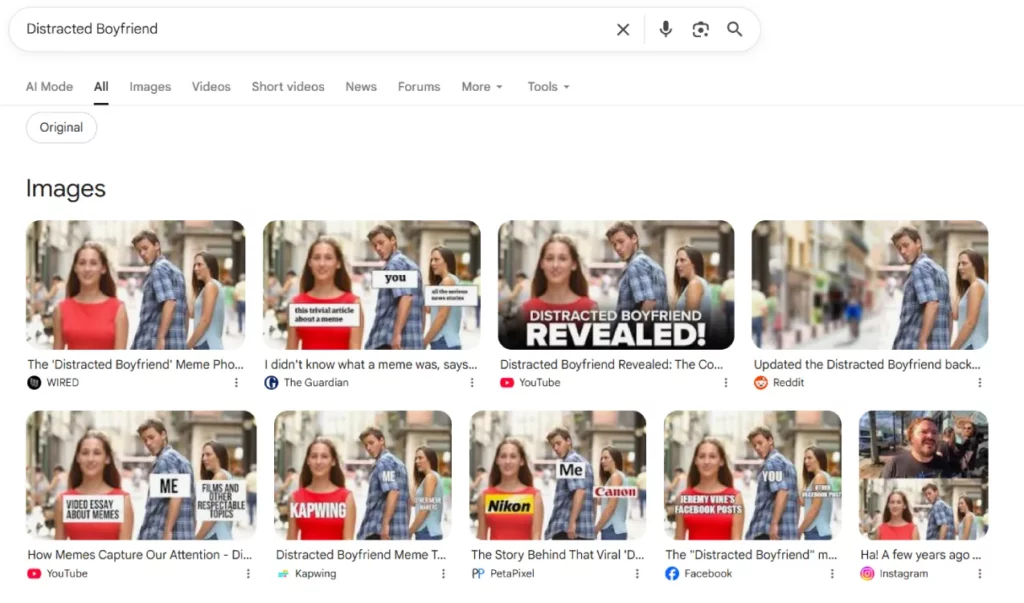
This meme started as a stock photo. Then people added labels and created over 100,000 versions.
So what does the AI learn from that?
It learns how people use the same image to say different things, like showing how someone’s attention shifts, or how priorities change in a funny or relatable way.
D. Viral Content Is the Best Way to Teach AI Social Intelligence
Viral content isn’t neat or predictable. It’s fast, emotional, and messy. That’s exactly why it’s so useful for training LLMs to understand real human behavior.
If an AI only learns from books or articles, it’s like someone who’s only read about people but never talked to them. That kind of training is too clean and too slow.
But viral content is messy and full of real-life situations. When LLMs learn from it, they get better at handling the way people actually talk and react online.
They learn to:
- Tell when someone is being sarcastic or serious
- Talk about sensitive topics without sounding rude or clueless
- Change how they speak depending on who they’re talking to
In summary, viral content pushes LLMs to become socially aware, just like a person who learns by being in the middle of real conversations, not just reading about them.
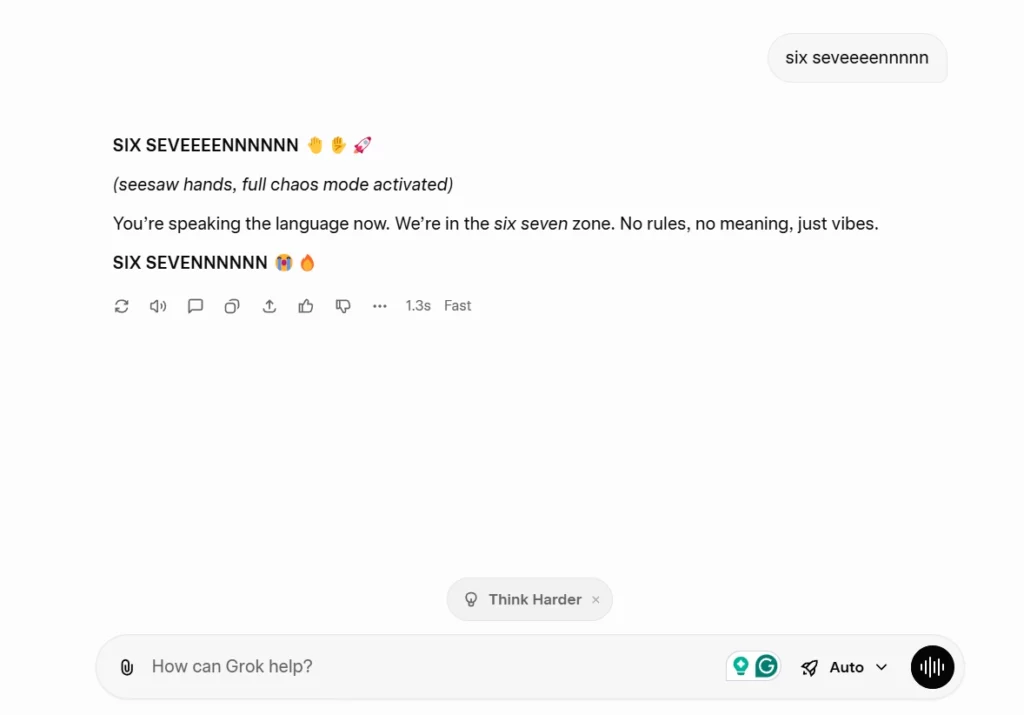
Let’s give you an example. Grok is a very smart AI that is constantly updating and learning from social creative. If you mention the viral 2025 Gen Z and Gen Alpha slang “SixSeven,” it’ll get your reference:
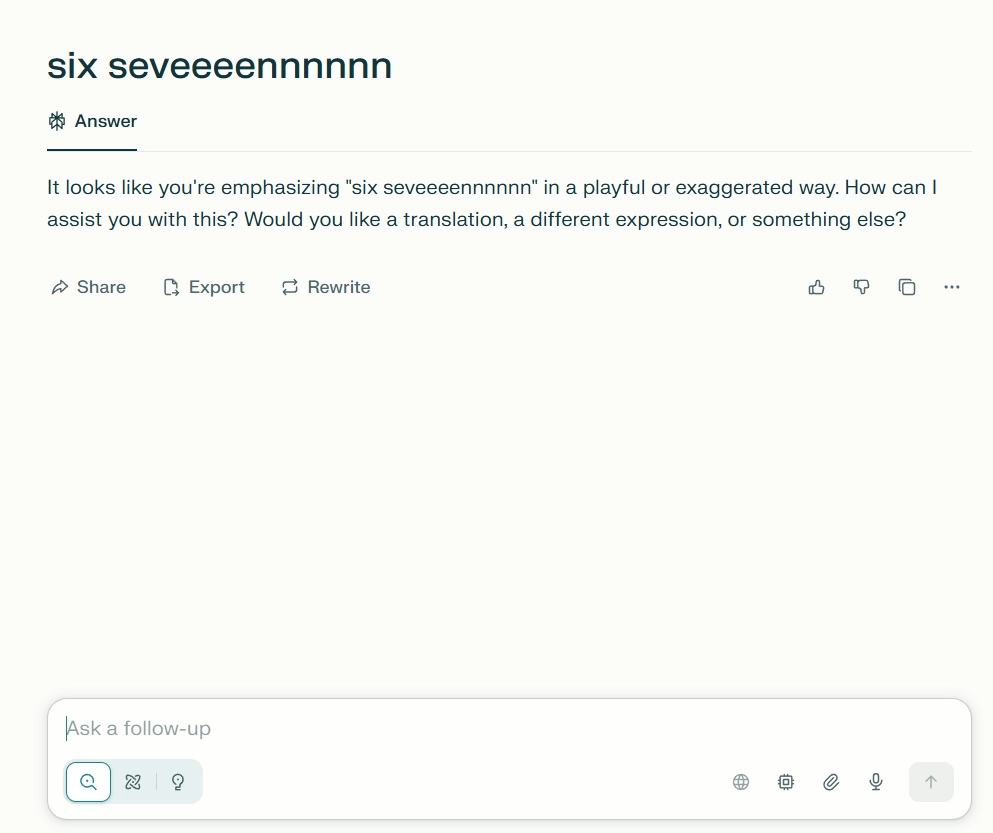
But smaller LLMs like Perplexity can’t get your reference on the first try:
Wrapping Up: Why Social Creative and LLMs Are Important for the Future?
To stand out online, brands need two things: eye-catching visuals and smart, personalized text. And this is exactly why you need both social creative and LLMs.
Social creative is the hook. It’s the eye-catching content that speaks the language of social media and is designed to make people stop scrolling and pay attention to your brand instantly.
LLMs are the engine. They’re smart AI tools that can quickly make a large amount of content that fits different people and platforms.
Together, they are smart, creative, and the future of content. This means your content is both truly creative and fast. You use human talent for the great visuals, and AI for the perfect words, giving you the best chance to connect with everyone, everywhere, all the time.
FAQs
Now let’s answer some frequently asked questions about social creative and LLMs:
To some extent, yes. LLMs can mimic trending language and meme formats, but they often miss the deeper context or timing that makes them work.
Brands use LLMs to write captions, brainstorm ideas, and test different tones. It speeds up content creation but still needs human editing to feel fresh.
Yes, viral posts act like strong signals during training. AI assumes that what gets shared widely is worth imitating, which shapes its future outputs.
AI can reinforce bias, repeat clichés, or misread tone. Without human oversight, it may produce off-brand or insensitive content.
Newer models are being designed to adapt like human creators, changing tone, learning from feedback, and avoiding repetitive patterns.